American-Made Socks and the U.S. Textile Industry: What's Left, and Who Still Knits Here
U.S. apparel employment fell 92% since 1990. Here's what happened to American sock and textile mills, who still knits socks here, and how to check the label.
Key takeaways
- Employment in U.S. apparel manufacturing fell from 891,500 in September 1990 to 71,400 in September 2026, a drop of about 92% (BLS).
- Textile mills went from 488,300 jobs to 78,100 over the same period, and textile product mills from 232,900 to 93,700.
- Fort Payne, Alabama, once produced more than 3 million pairs of socks a week and employed about 5,000 people in the 1990s; most of that production moved overseas in the 2000s.
- American sock makers still operate, including Wigwam in Sheboygan, Wisconsin (since 1905) and Darn Tough, made by Cabot Hosiery Mills in Northfield, Vermont, which launched the Darn Tough line in 2004.
Socks are one of the few pieces of clothing you can still find made in the U.S. without much effort. That's notable, because the American textile and apparel industry around them has shrunk dramatically. Here's what the federal jobs data shows, what happened to America's sock towns, and which mills are still knitting.
How much has the U.S. textile and apparel industry shrunk?
U.S. textile and apparel jobs, 1990 vs. 2026
All employees, thousands, September, seasonally adjusted
Sept. 1990Sept. 2026
September 2026 figures are preliminary. Sock and hosiery mills are counted within apparel manufacturing.
Source: BLS CES3231300001, CES3231400001, CES3231500001
View the data
| Industry | Sept. 1990 (thousands) | Sept. 2026 (thousands) |
|---|---|---|
| Textile mills | 488.3 | 78.1 |
| Textile product mills | 232.9 | 93.7 |
| Apparel manufacturing | 891.5 | 71.4 |
The Bureau of Labor Statistics (BLS) tracks three related industries:
- Textile mills spin yarn and make fabric. Employment fell from 488,300 in September 1990 to 78,100 in September 2026, down about 84%.
- Textile product mills turn fabric into goods like carpets, curtains and bags. Jobs fell from 232,900 to 93,700, down about 60%.
- Apparel manufacturing, which includes knitting mills that make socks and hosiery, fell from 891,500 to 71,400, down about 92%.
Combined, the three went from about 1.6 million jobs to about 243,000. Over the same period, total U.S. manufacturing employment fell about 28%, from 17.6 million to 12.65 million, so textiles and apparel shrank far faster than factories overall.
When did American clothing manufacturing decline?
U.S. apparel manufacturing jobs, 1990–2026
All employees, thousands, September of each year, seasonally adjusted
Source: BLS CES3231500001
View the data
| Year | Jobs (thousands) |
|---|---|
| 1990 | 892 |
| 1991 | 876 |
| 1992 | 870 |
| 1993 | 849 |
| 1994 | 833 |
| 1995 | 779 |
| 1996 | 712 |
| 1997 | 670 |
| 1998 | 610 |
| 1999 | 523 |
| 2000 | 472 |
| 2001 | 392 |
| 2002 | 346 |
| 2003 | 291 |
| 2004 | 275 |
| 2005 | 244 |
| 2006 | 228 |
| 2007 | 211 |
| 2008 | 199 |
| 2009 | 164 |
| 2010 | 154 |
| 2011 | 152 |
| 2012 | 147 |
| 2013 | 144 |
| 2014 | 139 |
| 2015 | 136 |
| 2016 | 130 |
| 2017 | 115 |
| 2018 | 112 |
| 2019 | 109 |
| 2020 | 89.3 |
| 2021 | 91.7 |
| 2022 | 91.4 |
| 2023 | 89.1 |
| 2024 | 82.6 |
| 2025 | 78.7 |
| 2026 | 71.4 |
The apparel decline started earlier than the broader factory collapse of the 2000s. Apparel jobs fell from 891,500 in 1990 to 472,400 in 2000, nearly halving in a decade, then to 153,500 in 2010. Since then the losses have been slower but steady: 89,300 in 2020 and 71,400 in 2026.
Textile mills followed a similar path, with a steep drop between 2000 (376,200) and 2010 (118,300). The 1990s and 2000s brought major changes to global trade in clothing and textiles, and much of the production moved to countries with lower labor costs.
What happened to America's sock capital?
Fort Payne, Alabama, is the clearest example. According to the Encyclopedia of Alabama, the town's hosiery industry began with the Florence Knitting Company in October 1907. By the 1990s, Fort Payne's mills produced more than 3 million pairs of socks a week and employed about 5,000 people.
Then, in the 2000s, most of that production moved overseas. The town now has a hosiery museum telling the story. Fort Payne's arc mirrors the national chart above: a long-established American industry that shrank in a little over a decade.
Who still makes socks in the USA?
Some of the best-known survivors are family businesses that kept knitting at home.
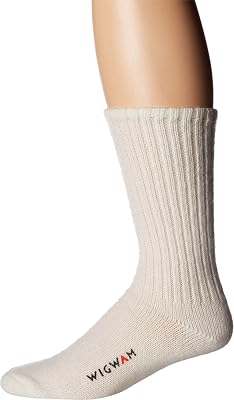
Wigwam: Sheboygan, Wisconsin, since 1905
According to Wigwam's company history, the business began as the Hand Knit Hosiery Company in 1905, formed after a 1904 fire destroyed the Sheboygan Knitting Company. Its founders included Herbert Chesebro, Lawrence A. Bentz and Robert H. Ehaney. The company took the Wigwam name in 1957 and began building a 200,000-square-foot plant in the Sheboygan Industrial Park in 1970. It added a merino wool line in 1996 and still runs an outlet in its factory building. See more products made in Wisconsin or the Wigwam brand page.
Darn Tough: Northfield, Vermont
Darn Tough socks are made by Cabot Hosiery Mills in Northfield, Vermont. According to the company, Ric Cabot joined his father Marc in the business in 1989. The first Darn Tough sock came in 2004, debuting with 3,500 pairs at the Vermont City Marathon, backed by what the company calls the industry's first lifetime guarantee. Darn Tough has since added a mill in Waterbury, reviving the historic Nantanna Mill. See made in Vermont and the Darn Tough brand page.


How can you tell if socks are made in the USA?
Socks have a labeling rule that makes this easier than most clothing. Under the Textile Fiber Products Identification Act, as explained by the Federal Trade Commission, socks sold in packages must show the country of origin on the front of the package, next to the size. Look for:
- "Made in USA" with no qualifier. This means the socks were made in the U.S. of U.S.-made materials, under the FTC's textile rules.
- "Made in USA of imported yarn" or similar. The knitting happened here, but the yarn didn't.
- "Imported" or a foreign country name. Made abroad, even if the brand is American.
For online listings, the FTC requires sellers of textile products to say whether a product is made in the USA, imported, or both. Our step-by-step guide to reading clothing labels covers fiber content and RN numbers, and what "Made in USA" legally means covers the broader FTC standard.
Are American-made socks worth it?
That depends on what you value, and we don't track prices. A few points to weigh:
- Durability guarantees. Some U.S. makers back their socks with long-term guarantees. Darn Tough's lifetime guarantee is the best-known example.
- Jobs. With only about 71,000 apparel manufacturing jobs left nationally, each surviving mill is a meaningful local employer.
- Transparency. Domestic mills that tell you where they knit, like Sheboygan or Northfield, make it easier to know what you're buying.
Browse all American-made apparel in our directory, or explore products by state.
About this data
Employment figures are from the BLS Current Employment Statistics survey (series CES3231300001, CES3231400001, CES3231500001 and CES3000000001), all employees, seasonally adjusted, September values, downloaded from the BLS public data API. Percentage changes are our calculations. September 2026 figures are preliminary. Company histories come from Wigwam's and Darn Tough's own websites; Fort Payne figures come from the Encyclopedia of Alabama.
Sources
- All Employees, Textile Mills (CES3231300001)U.S. Bureau of Labor Statistics
- All Employees, Textile Product Mills (CES3231400001)U.S. Bureau of Labor Statistics
- All Employees, Apparel Manufacturing (CES3231500001)U.S. Bureau of Labor Statistics
- Fort PayneEncyclopedia of Alabama
- Our StoryWigwam Mills
- Company HistoryDarn Tough Vermont
- Threading Your Way Through the Labeling Requirements Under the Textile and Wool ActsFederal Trade Commission