How to Host an American-Made Thanksgiving: A Shopping Guide From Turkey to Pie Pan
A practical guide to an American-made Thanksgiving: where U.S. turkeys and cranberries come from, how to read meat labels, and U.S.-made pantry staples and pans.
Key takeaways
- Thanksgiving is Thursday, November 26, 2026. Shop in three rounds: cookware and tableware first, shelf-stable pantry items next, and the turkey and fresh produce last.
- Nearly every turkey in the store was raised here: USDA forecasts 199 million turkeys raised in the U.S. in 2026, led by Minnesota (34.0 million) and North Carolina (29.5 million).
- Since January 1, 2026, "Product of USA" on turkey and other meat or poultry means the bird was born, raised, slaughtered and processed in the United States.
- Cranberries are a native U.S. crop: Wisconsin typically grows about 60% of the U.S. harvest and Massachusetts about 25%, according to USDA.
- You can fill the pantry and the table with U.S.-made staples, from Idaho potatoes and North Dakota flour to Tennessee cast iron and West Virginia plates.
Yes, you can put an almost entirely American-made Thanksgiving on the table, and it's easier than most holiday shopping. The turkey and cranberries are very likely grown in the U.S. already. The pans, plates and many pantry staples can come from U.S. factories and mills with a little label reading. This year, Thanksgiving falls on Thursday, November 26, 2026, so you have a little over three weeks to plan.
This guide covers where the main ingredients come from, what the labels mean, and which U.S.-made products in our directory fit each part of the meal. We don't list prices, because they change daily.
Where does your Thanksgiving turkey come from?
Almost certainly from a U.S. farm. In its Turkeys Raised report released September 25, 2026, USDA's National Agricultural Statistics Service (NASS) forecast 199 million turkeys raised in the United States in 2026, up 3% from 2025.
Production is concentrated in a handful of states. Minnesota leads with 34.0 million birds, followed by North Carolina at 29.5 million, Arkansas at 21.0 million and Indiana at 20.0 million. NASS says the top six states, including Missouri (16.0 million) and Virginia (14.5 million), account for 68% of U.S. turkeys.
Where America's turkeys are raised
Turkeys raised in 2026, forecast, millions of birds (top 8 states)
Preliminary estimates released September 25, 2026, for turkeys placed September 1, 2025, through August 31, 2026. NASS reports thousands of head; we converted to millions. U.S. total: 198.5 million. Final figures come out in April.
Source: USDA NASS, Turkeys Raised (Sept. 25, 2026)
View the data
| State | Turkeys raised, 2026 forecast (millions) |
|---|---|
| Minnesota | 34.0 M |
| North Carolina | 29.5 M |
| Arkansas | 21.0 M |
| Indiana | 20.0 M |
| Missouri | 16.0 M |
| Virginia | 14.5 M |
| Iowa | 11.5 M |
| Pennsylvania | 8.2 M |
Turkey is also a big business for those states. NASS's 2025 summary valued U.S. turkey production at $5.58 billion, up 51% from $3.69 billion in 2024, on 6.22 billion pounds of turkey. Buying a bird raised in your own state, or in a neighboring one, keeps more of that money close to home.
How to buy local: ask at the meat counter where the store's turkeys come from, or order from a farm near you. Small farms often take holiday orders early, so call soon.
What does "Product of USA" mean on a turkey label?
It now has a strict meaning. Under a USDA Food Safety and Inspection Service (FSIS) rule with mandatory compliance from January 1, 2026, the voluntary claims "Product of USA" and "Made in the USA" on meat and poultry may be used only if the animal was born, raised, slaughtered and processed in the United States. Before the rule, a product only had to be processed here to carry the label.
For stuffed turkeys, gravies and other multi-ingredient products, the rule also requires all ingredients other than spices and flavorings to be of U.S. origin, with processing in the U.S. Our explainer on the Product of USA meat label rule covers the details and what shoppers believed the label meant.
Are cranberries an American crop?
Yes. Cranberries are native to North America, and the U.S. crop is grown mainly in a few states. USDA's Economic Research Service says Wisconsin typically harvests about 60% of the U.S. crop and Massachusetts about 25%, with smaller harvests in Oregon and New Jersey.
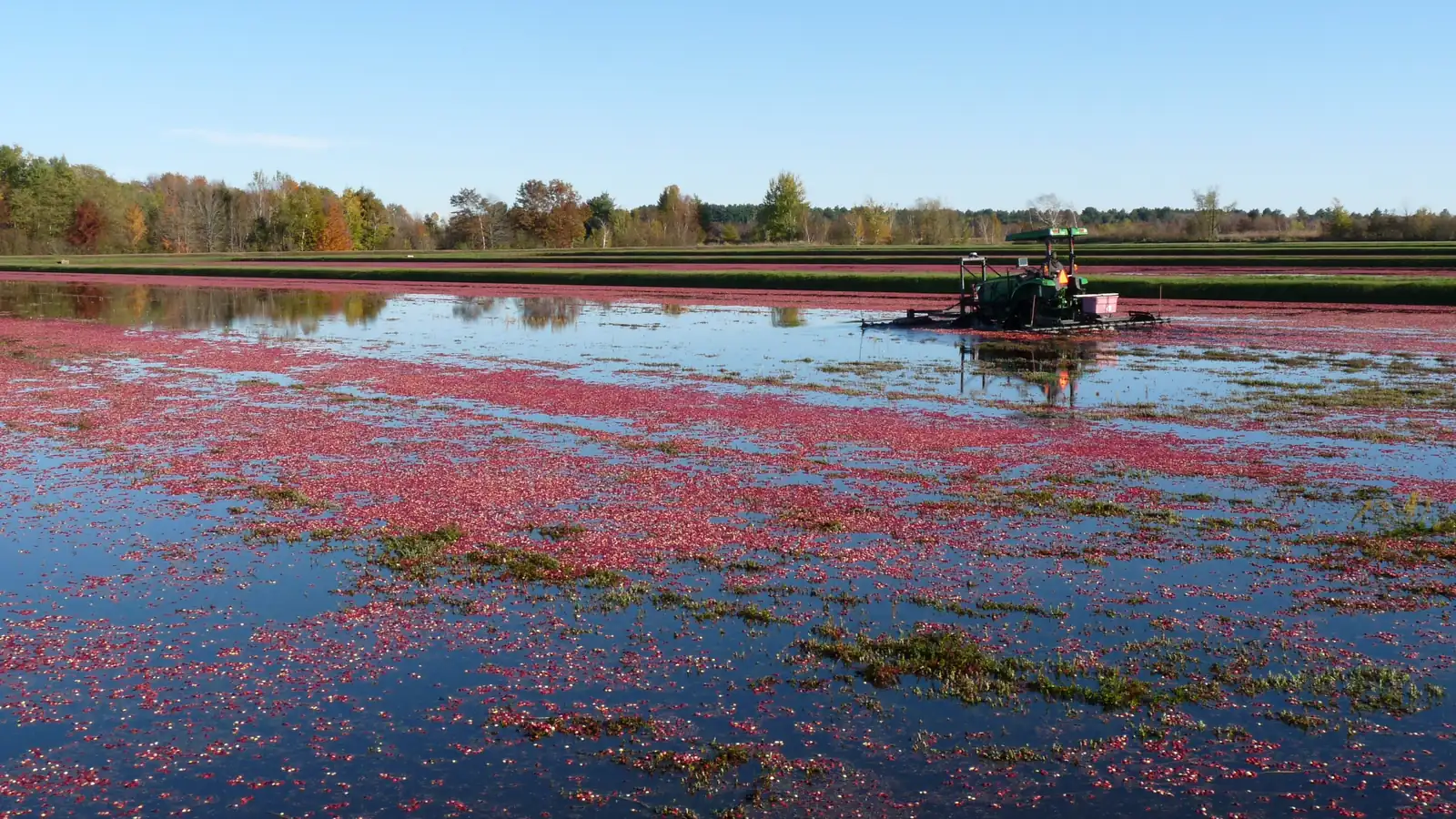
The header photo shows a bog in Cranmoor, Wisconsin, flooded so the berries float for harvest. Fresh cranberries are widely available from October to December, according to USDA; the rest of the crop becomes juice, sauce and dried fruit sold all year. Bagged fresh cranberries usually list the grower or packer, which is an easy way to check the state.
Which pantry staples are made in the USA?
Most of the side dishes and desserts rely on shelf-stable ingredients, and many classic brands still make them here. All of these are in our directory with a cited source for where they're made:
- Mashed potatoes: Idahoan buttery homestyle mashed potatoes are made in Lewisville, Idaho, a shortcut if your oven and stovetop are full.
- Flour for rolls and pie crust: Dakota Maid all-purpose flour is milled in Grand Forks, North Dakota, by the state-owned North Dakota Mill. See more from Dakota Maid.
- Baking powder: Clabber Girl double-acting baking powder comes from Terre Haute, Indiana.
- Cornbread dressing: Kenyon's Grist Mill in West Kingston, Rhode Island, makes a johnny cake corn meal mix.
- Canned tomatoes for soups and casseroles: Red Gold diced tomatoes are made in Elwood, Indiana.
- Pecans for pie: Heaton Pecans pecan halves come from Lyon, Mississippi. For a nuttier, old-fashioned flavor, Hammons black walnuts come from Stockton, Missouri.
- Syrup for pie and sweet potatoes: Golden Eagle syrup is made in Fayette, Alabama.
- Cheese board: Maytag Dairy Farms blue cheese is made in Newton, Iowa.


For more, see our ranked best American-made pantry staples and sauces and the full grocery category.
What cookware do you need for the big meal?
You don't need a special-occasion roaster to cook a turkey. A heavy pan and a sheet pan go a long way:
- Dutch oven: the Lodge 5-quart Dutch oven handles a turkey breast, braised sides or a big batch of gravy. Lodge pours its cast iron in South Pittsburg, Tennessee.
- Cast iron skillet: the Lodge 10.25-inch skillet bakes cornbread for dressing and roasts vegetables.
- Sheet pans: a Nordic Ware half sheet (Minneapolis; Nordic Ware notes this line uses some imported materials) or a USA Pan half sheet (Crescent, Pennsylvania) for rolls and roasted squash.
- Loaf pan: the USA Pan loaf pan for pumpkin or cranberry bread.
- Measuring cup: the Pyrex 2-cup glass measuring cup doubles as a gravy pitcher.
Our American-made kitchen starter kit explains each pick in more depth, and the best American-made kitchen and cookware list compares makers side by side.
How do you set an American-made table?
The table is where U.S.-made pieces show, and they last for many holidays.
- Plates: Fiesta dinner plates are made in Newell, West Virginia.
- Water pitcher: a hand-blown Blenko Glass water bottle from Milton, West Virginia, works as a carafe.
- After dinner: Community Coffee is roasted in Port Allen, Louisiana. Celestial Seasonings Sleepytime tea is blended in Boulder, Colorado, from globally sourced botanicals, which is why we list it with a qualified verdict.
Shopping for a host gift? See our state-by-state holiday gift guide and best American-made gifts list.
When should you shop for each part of the meal?
Three rounds keep it calm:
- Now through mid-November: cookware, bakeware and tableware. These ship and store easily, and online orders have time to arrive.
- About two weeks out: shelf-stable pantry items, including flour, baking powder, cornmeal, canned tomatoes, nuts, syrup and coffee.
- The final week: the turkey (a frozen bird needs several days to thaw safely in the refrigerator, so buy it early in the week), fresh cranberries, potatoes, squash and other produce. Buy produce from a farmers market or farm stand if one is still open near you.
Before you buy anything labeled "Made in USA," remember the bar the Federal Trade Commission sets in 16 CFR 323: an unqualified claim means all or virtually all of the product is made in the U.S. Wording such as "assembled in USA" or "with imported parts" is a qualified claim. Our 6-step verification checklist shows how to check, and if you shop online, read how to shop American-made on Amazon first.
Where can you find more American-made holiday picks?
- Browse makers by state: Minnesota, North Carolina, Indiana, Missouri, Virginia, Iowa and Wisconsin.
- See what's new in the directory or all of our best-of lists.
Start with the turkey and cranberries, which are likely U.S.-grown already, swap a few pantry staples, and add one durable pan you'll use for years.
The American-Made Edit
Enjoyed this? Get the American-Made Edit
New verified American-made finds and Made in USA news by email, a few times a month.
You’re on the list.
Thanks for subscribing. Look for The American-Made Edit in your inbox; you can unsubscribe from any email.
Sources
- Turkeys Raised (September 25, 2026)USDA National Agricultural Statistics Service, September 25, 2026
- Poultry - Production and Value 2025 SummaryUSDA National Agricultural Statistics Service, April 2026
- Turkey Sector: Background & StatisticsUSDA Economic Research Service, accessed November 2, 2026
- Cranberry production forecast to land near five-year average in 2025USDA Economic Research Service, Charts of Note, November 26, 2025
- Voluntary Labeling of FSIS-Regulated Products With U.S.-Origin Claims (final rule)Federal Register (USDA Food Safety and Inspection Service), March 18, 2024
- 16 CFR Part 323, Made in USA LabelingElectronic Code of Federal Regulations (Federal Trade Commission rule), accessed November 2, 2026